
No New Haven County Mugshot Gallery
There is no New Haven County sheriff mugshot gallery. There is no county jail roster booking-photo page either. The reason is structural. Connecticut folded its county jails and state prisons into one agency, the Connecticut Department of Correction, back in 1968. New Haven County never kept a sheriff-run jail after that. So the booking-photo feed that other states post at the county level simply has no home in Connecticut.
The state does run a public custody search. It is the CT DOC inmate information search, and it covers people held statewide. That includes New Haven Correctional Center, Cheshire Correctional Institution, and Manson Youth Institution. The tool is a statewide search by person, though, not a county booking-photo gallery. You look up one name at a time. You do not browse a wall of recent faces.
CT DOC rules do list an inmate photo among the details the agency may share about a current offender. The catch is access. The public locator was built to confirm custody and status, not to publish a county mugshot feed. A booking photo, when it exists in public form, is requested from the office that holds it.
CT DOC Photos vs Police Booking Photos
Two different offices can hold a photo of the same person, and they are not the same record. The first is the arresting agency. When municipal police or the Connecticut State Police book someone, they create an arrest record and may take a booking photo at processing. That photo lives with the police department, not with the state. The second holder is CT DOC. When a person is admitted into state custody, the Department keeps its own offender photo in its records system.
This split matters for where you ask. A booking photo taken at arrest, before any state admission, is a police record. You request it from the city or state police agency that made the arrest. A DOC photo of someone already in custody is a Department record. You ask the DOC Public Information Office for further offender details beyond what the locator shows.
The official CT DOC inmate information page sets out the disclaimer and the office that fields these requests. The image below shows that page.
The Department's own custody and offender-information overview is published at the CT DOC inmate information page, which names the Public Information Office and the daily-update notice.
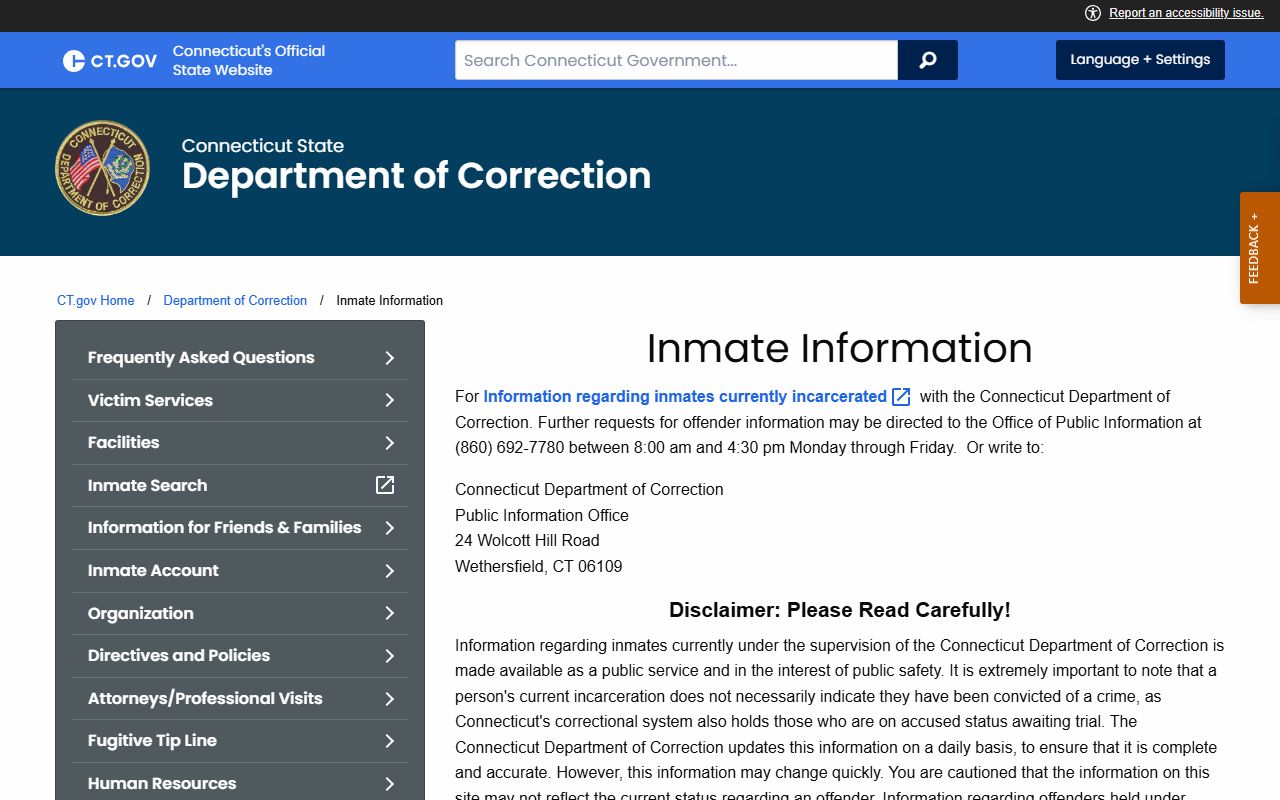
That page explains that current incarceration does not prove conviction, since the state holds accused and pretrial people too. It also points requesters to the Public Information Office when they need more than the locator shows.
What Connecticut Arrest Law Makes Public
Connecticut treats records of arrest as public from the moment of arrest, with limits. The core rule is C.G.S. 1-215, summarized in the statute box below. In plain terms, the arresting agency must make basic arrest facts public once an arrest is made. That set includes the person's name, race, and address, plus the date, time, and place of the arrest, and the offense. It also covers either the arrest warrant application and affidavit or the arrest, incident, or similar report.
The statute does not flatly command release of every booking photo by name. It does reach further than the basic facts, though. Section 1-215(c) covers other law-enforcement records that document or depict an arrest or custody during a pending prosecution, unless another exemption applies. Booking photos can fall under that language. Sealing, juvenile status, erasure, and active investigative files can still hold a record back.
So a booking photo is best treated as requestable, not as guaranteed online. You ask the agency that made or processed the arrest. Or you ask CT DOC where the Department keeps an inmate photo. The law that frames the whole system is the Connecticut Freedom of Information Act.
Key Statutes:
C.G.S. Chapter 14, Sec. 1-215 - makes records of arrest public from the time of arrest, with the basic arrest facts and the report or warrant affidavit released subject to sealing and other exemptions.
FOI Commission, Sec. 1-215 - the Freedom of Information Commission's plain reading of the arrest-record rule and its exceptions.
CT DOC Administrative Directive 4.4 - lists the current offender information the Department may release, including name, inmate number, status, controlling offense, location, dates, detainer, and inmate photo.
C.G.S. Chapter 961a - Connecticut's erasure statutes, which can wipe qualifying arrest and court records after dismissal, acquittal, a nolle waiting period, or a pardon.
How to Request a New Haven County Booking Photo
Finding a photo in Connecticut takes a few ordered steps, because the right office depends on who holds the image. Start by confirming custody. Then route your request to the agency that owns the record you want. The steps below move from the easiest public check to the formal requests.
- Search the CT DOC inmate locator first. Confirm that the person is in custody and note the facility, since New Haven County custody often means New Haven CC, Cheshire CI, or Manson YI.
- For a DOC photo or more offender detail, contact the CT DOC Public Information Office at (860) 692-7780, Monday through Friday, 8:00 a.m. to 4:30 p.m., or write to 24 Wolcott Hill Road, Wethersfield, CT 06109.
- For an arrest or booking photo made by city or state police before DOC admission, request it from the arresting department under the Connecticut FOI Act and C.G.S. 1-215.
- For a State Police arrest, use the DESPP reports and records request channels rather than the city police desk.
- For court files after an arrest, use the CT Judicial case lookup. Court records show charges and case events, not booking photos.
- For federal defendants, use the BOP inmate locator or the U.S. Marshals District of Connecticut. Neither posts public mugshots.
- For immigration custody, the ICE Online Detainee Locator System finds detainees but shows no booking photos.
The jail inmate records page walks through the locator search fields in more depth if you get stuck on step one.
Note: A DOC profile updates daily, not in real time, so a very recent booking may take a short while to appear in the public inmate search.
Connecticut State Police Photo Requests
Connecticut State Police handle arrests in many towns that have no large municipal force, and they keep their own records channel. When a state trooper makes the arrest, the booking and arrest report sit with the Department of Emergency Services and Public Protection, not a city police department. That changes where your request goes.
The records office for these requests is the State Police Bureau of Identification and the broader DESPP reports unit. The Bureau also runs the state criminal-history process, which is a separate product from a single booking photo. The page below shows the State Police records request landing point.
You can reach the Bureau through the official State Police Bureau of Identification page, which describes the criminal-history request and the records channels.
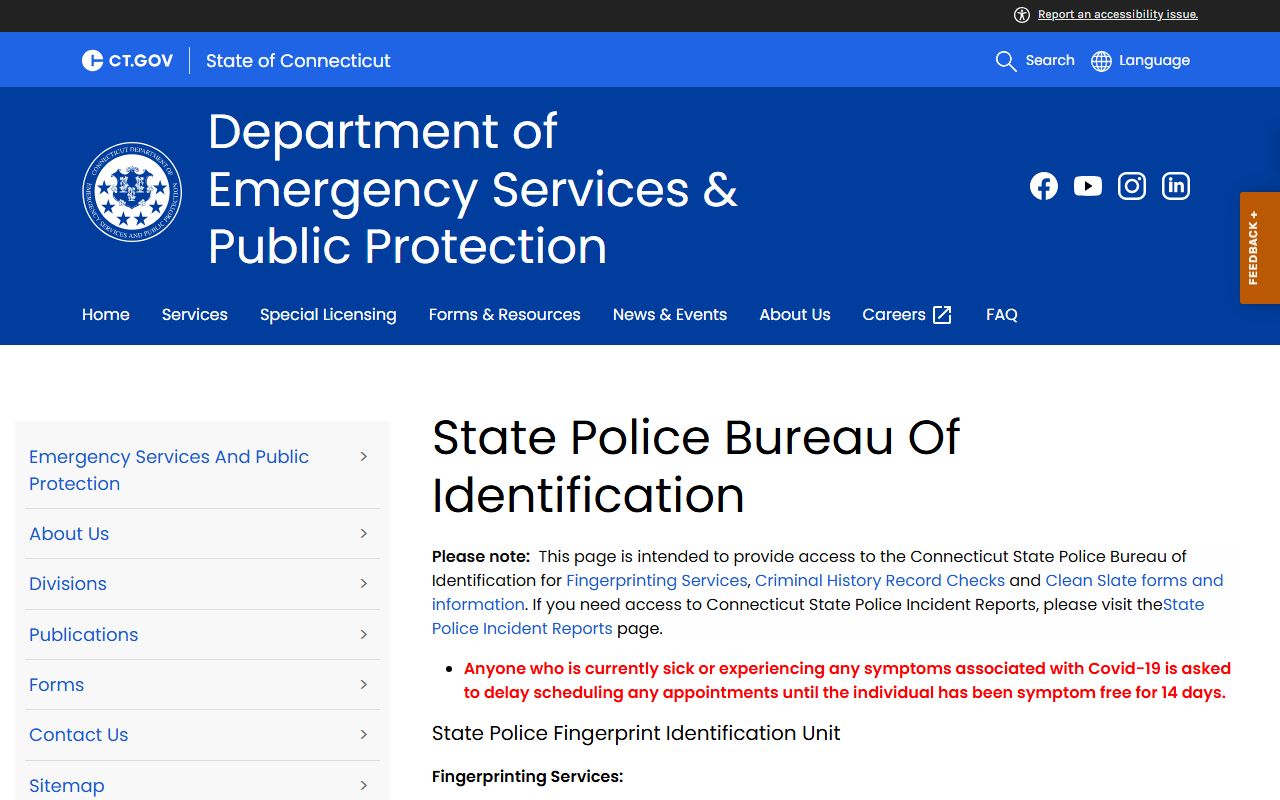
Use this office for a State Police arrest report or for a formal criminal-history check, and use the city police records desk when a local department made the arrest.
What Appears Beside a DOC Photo
When CT DOC does hold an inmate photo, it sits inside a profile of record fields rather than a county booking sheet. The Department draws these fields from its FAQ and from Administrative Directive 4.4. The photograph is one field among many. The table below highlights it and lists the other details a DOC information response may carry.
| Field | What It Shows |
|---|---|
| Photograph | The DOC inmate photo, listed as releasable, though public display varies and is not a county gallery. |
| Name | The person's DOC-listed name. |
| Inmate Number | The CT DOC identifier used to search, mail, and deposit funds. |
| Date of Birth | An identity confirmation field. |
| Status | Sentenced, or accused and unsentenced. |
| Controlling Offense | The main offense controlling custody or sentence. |
| Current Location | The facility, such as New Haven CC, Cheshire CI, or Manson YI. |
| Admission Date | The date received into DOC custody. |
| Sentence and Release Dates | Sentencing date and minimum, maximum, or estimated release dates where they apply. |
| Detainer | A hold from another agency, if one is listed. |
| Correctional and Disciplinary History | DOC history categories listed as releasable. |
A DOC profile does not work like a county booking report. It does not bundle an arresting agency, a booking number, a housing pod, a per-charge bond, and a local court date in one record. Those details live with the police and the courts. To pull the case side, search court records separately.
The split is the whole point. One record confirms custody and the controlling offense. Another holds the arrest photo and report. A third holds the charges. You assemble the full picture from more than one office.
Youthful Offender and Juvenile Photos Differ
Some photos are not public at all, by design. The public CT DOC inmate database leaves out Youthful Offender records. A youthful offender is a protected status for certain young defendants, and Connecticut shields that status from the open inmate search. So a person held under that status will not surface in the public locator, and a DOC photo will not be served through it.
Juvenile records go further still. They are confidential. They cannot be searched the way adult DOC or adult criminal-case records can. A juvenile booking photo is not a public document, and a secure juvenile program is not an adult inmate-search facility. Manson Youth Institution holds young people, and the youthful offender exclusion can apply to part of that population.
Note: Because youthful offender and juvenile records are excluded or confidential, a missing search result does not always mean the person was never in custody.
Mugshots in Federal and ICE Custody
Federal and immigration custody follow their own rules, and none of them post a public mugshot wall. The Federal Bureau of Prisons runs an inmate locator for sentenced federal inmates, and it confirms custody, but it does not publish booking photos. The U.S. Marshals Service, which holds many federal pretrial defendants, likewise does not run a public mugshot feed. For those cases, federal court records carry the substance.
Immigration custody is separate again. The ICE Online Detainee Locator System finds people in ICE custody by A-number or by biographical details. It is a locator, not a photo gallery, and it cannot search records for anyone under 18. CT DOC adds one more wall here. Its public inmate database excludes people held on behalf of ICE, so an immigration detainee will not appear in the state search.
The nearest in-state federal prison is FCI Danbury, which sits outside New Haven County. Federal defendants from this area may be moved between facilities, so the locator and the federal court record matter more than any single site photo.
Removing a New Haven County Mugshot
Connecticut law can remove qualifying records, and that reach can include arrest and court records. The main erasure statute is C.G.S. 54-142a, found in chapter 961a. Erasure means a qualifying record is treated as erased and made unavailable. It can apply after an acquittal, a dismissal, the end of a nolle waiting period, a pardon, or an eligible Clean Slate conviction. A nolle is a prosecutor's choice not to go forward, and Connecticut records generally erase after a set waiting period if the case is not reopened.
The law also puts a duty on data buyers. C.G.S. 54-142e requires purchasers and mass requesters of criminal matters of public record to update their files and delete records that have been erased. That duty is one official lever against stale records floating around. Connecticut's Clean Slate access page explains how eligible convictions are erased, and the DESPP Clean Slate hearing form covers the dispute route.
Commercial mugshot sites are a different matter from official records. Their policies are their own, separate from the duties Connecticut places on official record holders, and the erasure route works through the courts and the state, not through any pay-to-remove service. To follow the case and erasure side, see the court records after a jail arrest page.
What is and isn't public: The public can see CT DOC locator profile data on current offenders and basic arrest records under C.G.S. 1-215. What the public cannot freely browse includes booking photos held by an arresting agency, youthful offender and juvenile records, people held for ICE, and records that have been erased. Those need a records request, or they are withheld outright.
New Haven County Booking Photo Terms
The records process leans on a few legal terms that are easy to confuse. The short list below defines the ones that decide whether a photo is open, requestable, or sealed in New Haven County.
- Erasure
- A Connecticut process that treats a qualifying criminal record as erased and makes it unavailable after a qualifying outcome.
- Nolle
- A prosecutor's decision not to proceed on a charge. The record generally erases after a statutory waiting period if the case is not reopened.
- Youthful Offender
- A protected status for certain young defendants. These records are excluded from the public DOC inmate database.
- Detainer
- A hold or notice placed by another agency that can keep a person in custody even when local matters are resolved.
- Accused
- CT DOC status for a person held before trial. It does not mean the person has been convicted.