
New Haven County Court Records After a Jail Arrest
Connecticut runs custody differently than most states. There is no county sheriff jail and no county district attorney. Police make the arrest. If the person is not released, custody moves to the Connecticut Department of Correction, since the state merged county jails and prisons into one system back in 1968. The prosecutor is a State's Attorney tied to a judicial district, not a county DA. That State's Attorney files the formal charges. Once those charges are entered by the court, the case shows up in the Connecticut Judicial Branch case lookup. That case file is the court record born from the arrest.
Two record sides exist after a booking, and people mix them up. The custody side covers where the person is held and the early booking detail. For that, the jail inmate records page walks through the state custody search, and the jail roster mugshots page handles booking photos. The court side is the charge record itself. It lists the offenses the State's Attorney filed, the docket number, court dates, and the outcome. The arrest charge and the court charge can differ, so the court records carry the version that actually moves through the case.
Two Judicial Districts Cover New Haven County
New Haven County does not sit in one court district. It splits between two. The New Haven Judicial District handles the central and northern towns. The Ansonia-Milford Judicial District handles the western and shoreline towns. Each district has its own State's Attorney and its own clerk offices. Where a person was arrested usually decides which district holds the court record. So the first step is to match the arrest town to the right district before you search.
The split matters for finding charges fast. A case from Hamden or Meriden lives in the New Haven district courts. A case from Derby or West Haven lives in the Ansonia-Milford courts. The table below sorts the county's towns by district so the search starts in the right place.
| New Haven Judicial District | Ansonia-Milford Judicial District |
|---|---|
| Branford | Ansonia |
| Bethany | Beacon Falls |
| Cheshire | Derby |
| East Haven | Milford |
| Guilford | Orange |
| Hamden | Oxford |
| Madison | Seymour |
| Meriden | Shelton |
| New Haven | West Haven |
| North Branford | |
| North Haven | |
| Wallingford | |
| Woodbridge |
The New Haven Judicial District names John P. Doyle, Jr. as State's Attorney. The Ansonia-Milford district names Margaret E. Kelley. Both offices prosecute the cases that turn an arrest into a court record. Note: the State's Attorney sets the filed charges, but the searchable court file lives with the Judicial Branch, not with the prosecutor's office.
How to Find New Haven County Court Records After an Arrest
The court records after an arrest live in the Connecticut Judicial Branch case lookup, not in a county portal. The booking and custody detail stays on the state inmate search instead. So the search runs in two lanes. Check custody first if you need to know where the person is held. Then move to the court lookup for the filed charges and the case status.
The Judicial Branch hosts the main entry point for criminal and motor vehicle cases. From there you can search pending cases, look up convictions, or pull a case by its docket number. The steps below run from custody to the court file.
- Search the Connecticut Department of Correction inmate locator to confirm current custody and facility.
- Open the Judicial Branch criminal and motor vehicle case lookup and pick the pending search by defendant.
- Enter the last name and narrow with first initial, birth year, and the likely court location.
- If you have the docket number from court paperwork, search by docket number instead for a direct hit.
- Compare the court charges to the arrest charges, since the prosecutor's filed charge can differ from the booking charge.
- For older or document-level records, contact the clerk's office for the court that heard the case.
The Judicial Branch criminal lookup hub gathers each of these searches in one place, and you can see its layout on the official case lookup page.
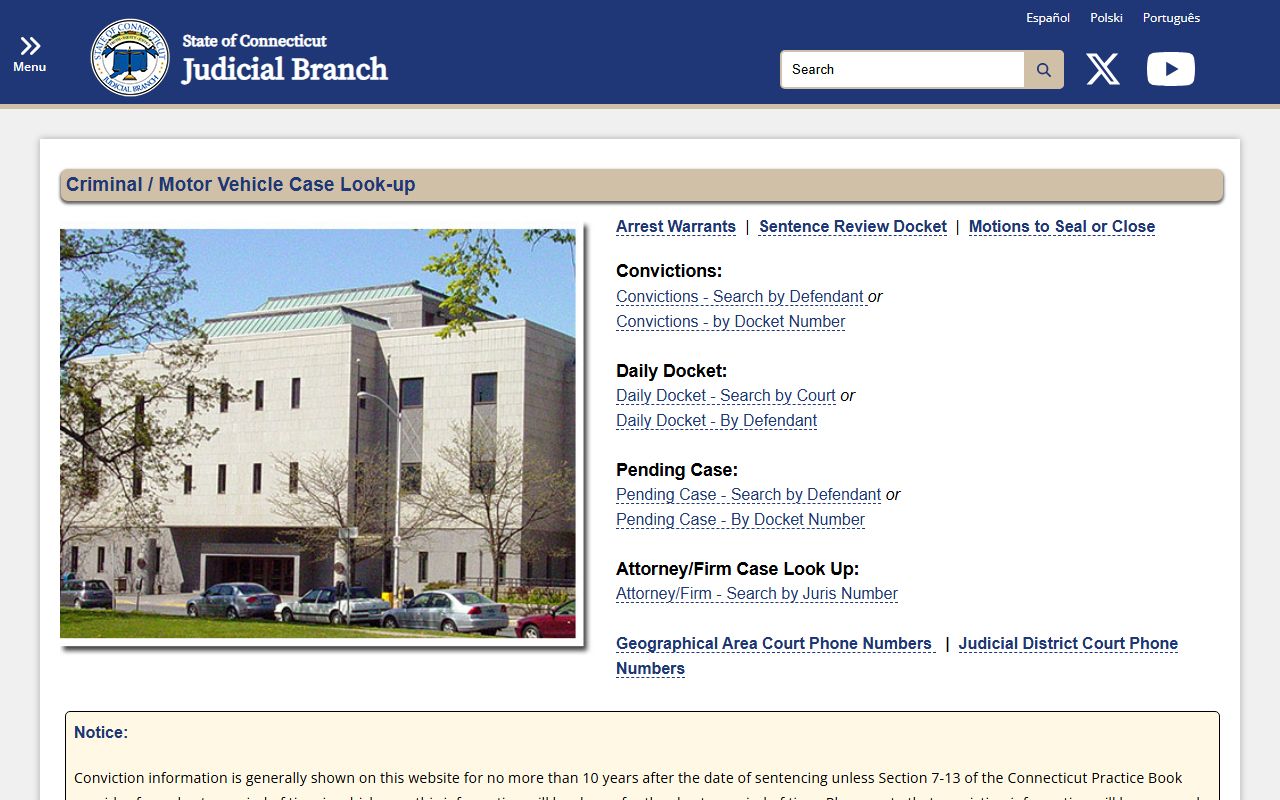
That hub links the pending search, the conviction search, the docket-number search, and the daily docket. It is the front door for nearly every court record that follows an arrest in the county. For an official criminal-history report, a separate state agency handles that request, which is covered further down.
New Haven County Pending Case Search
Most people start with the pending search. It finds open criminal and motor vehicle cases by the defendant's name. The same field set also drives the conviction search, which looks at disposed cases. Last name is the one required field. Everything else just narrows the list, which helps when a common name returns many matches.
The court location dropdown is the most useful narrowing tool. It carries the New Haven County options such as the New Haven Geographical Area courts, the New Haven Judicial District, Meriden, Milford, and Derby. Geographical Area, or GA, is the lower court tier. Judicial District, or JD, is the higher tier for serious cases.
| Field Label | Type | Required | Notes |
|---|---|---|---|
| Last Name (begins with) | text | Yes | Required on both the pending and conviction defendant searches. |
| First Initial | text | No | Optional narrowing field. |
| Birth Year | number | No | Optional; helps when the name is common. |
| Year Range +/- | number | No | Widens or tightens the search around the birth year. |
| Court Location | dropdown | No | New Haven GA 06, GA 08, GA 23, New Haven JD, Meriden GA 7, Milford GA 22, Derby GA 5, and statewide. |
| Category | radio | No | Criminal or Motor Vehicle; pending adds a license/registration suspension option. |
| Search | button | n/a | Runs the query. |
You can run this exact form on the pending criminal search by defendant page.
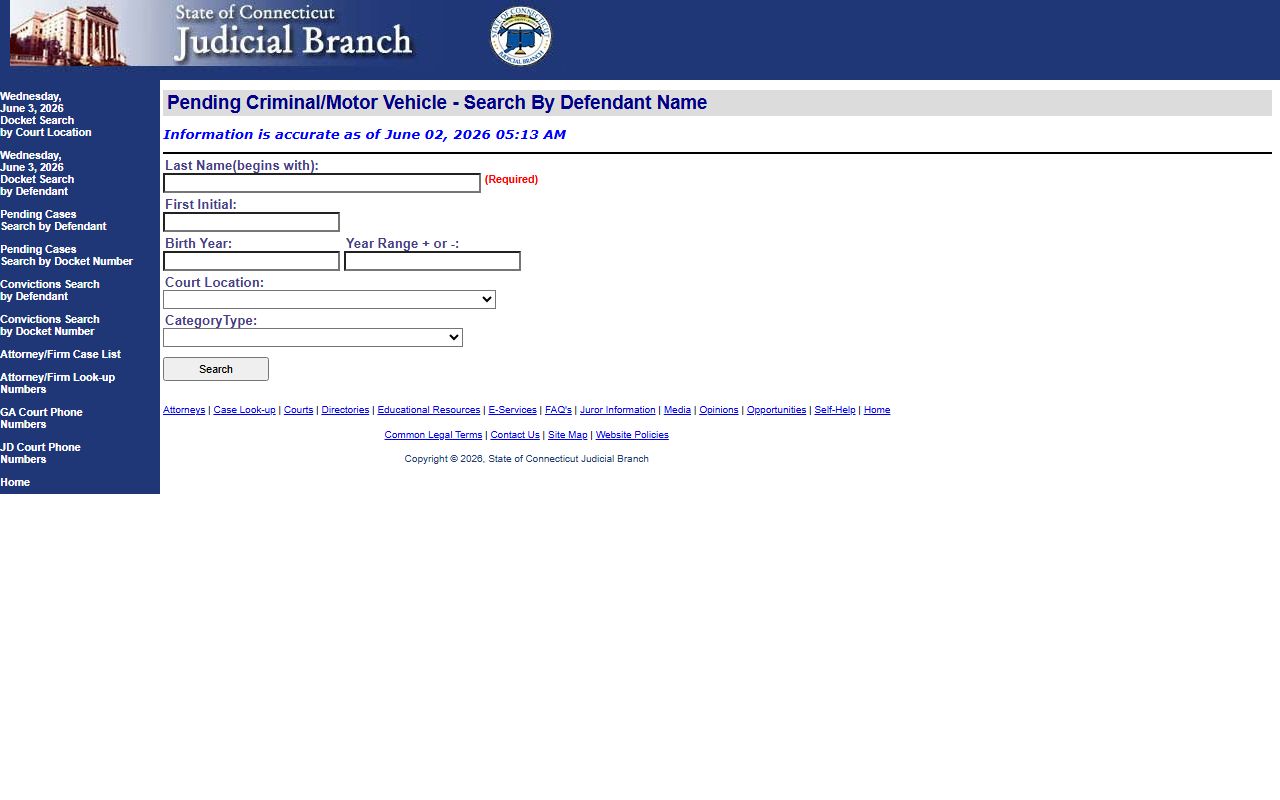
A result row shows the defendant name, docket number, court location, and the charge. Open the case to read the full charge list and the next court date. Note: a person held in custody may still show no court record yet if the court has not entered the case, so a same-day arrest can lag in the lookup.
Docket Number Search in New Haven County
If the arrest paperwork lists a docket number, that is the fastest path to the court record. A docket number search skips name matching entirely. It points straight at one case. Court notices, bond receipts, and release papers usually carry the number, so it is worth checking those first.
The docket number breaks into parts. The first part is the court code, which marks the GA or JD location. The type marks the case kind. Then the year and number identify the file. The table lays out each segment.
| Field Label | Type | Required | Notes |
|---|---|---|---|
| GA/JD Code | dropdown | Yes | New Haven-area codes include N06N, N07M, N08W, N23N, and NNH. |
| Type | dropdown | Yes | CR criminal, MV motor vehicle, CI, or MI. |
| Year | text | Yes | The docket year segment. |
| Number | text | Yes | The docket number segment. |
| Suffix | dropdown | No | Values such as S, T, A, or a single digit. |
| Search | button | n/a | Runs the query. |
The daily docket search rounds this out. It lists the cases set for a given court on a given day. That helps when you know a court date is coming but lack the docket number. The Judicial Branch warns that the daily docket may leave off add-on cases that get scheduled late, so a missing name does not always mean a missing case.
Part A and Part B Criminal Courts
Connecticut does not file charges by grand jury indictment as the standard path. The State's Attorney files the charges directly. How serious the case is decides which court handles it. The system splits into Part A and Part B. Part A takes the heavy felonies. Part B and the Geographical Area courts take the lighter offenses. Knowing the tier tells you which court record to search.
The New Haven Part A office sits at New Haven Superior Court and handles mostly class A and class B felonies. The Geographical Area offices, in Meriden and on Elm Street in New Haven, handle class C, D, and E felonies, plus misdemeanors, infractions, and motor vehicle offenses. The Ansonia-Milford district follows the same Part A and Part B split for its towns.
| Part A | Part B / GA | |
|---|---|---|
| Filed By | State's Attorney | State's Attorney |
| Court | New Haven Superior Court | Meriden and Elm Street, New Haven |
| Handles | Class A and B felonies | Class C/D/E felonies, misdemeanors, infractions, motor vehicle |
| Starts | The case record | The case record |
The New Haven Judicial District State's Attorney page lays out this Part A and Part B structure and lists the office contacts.
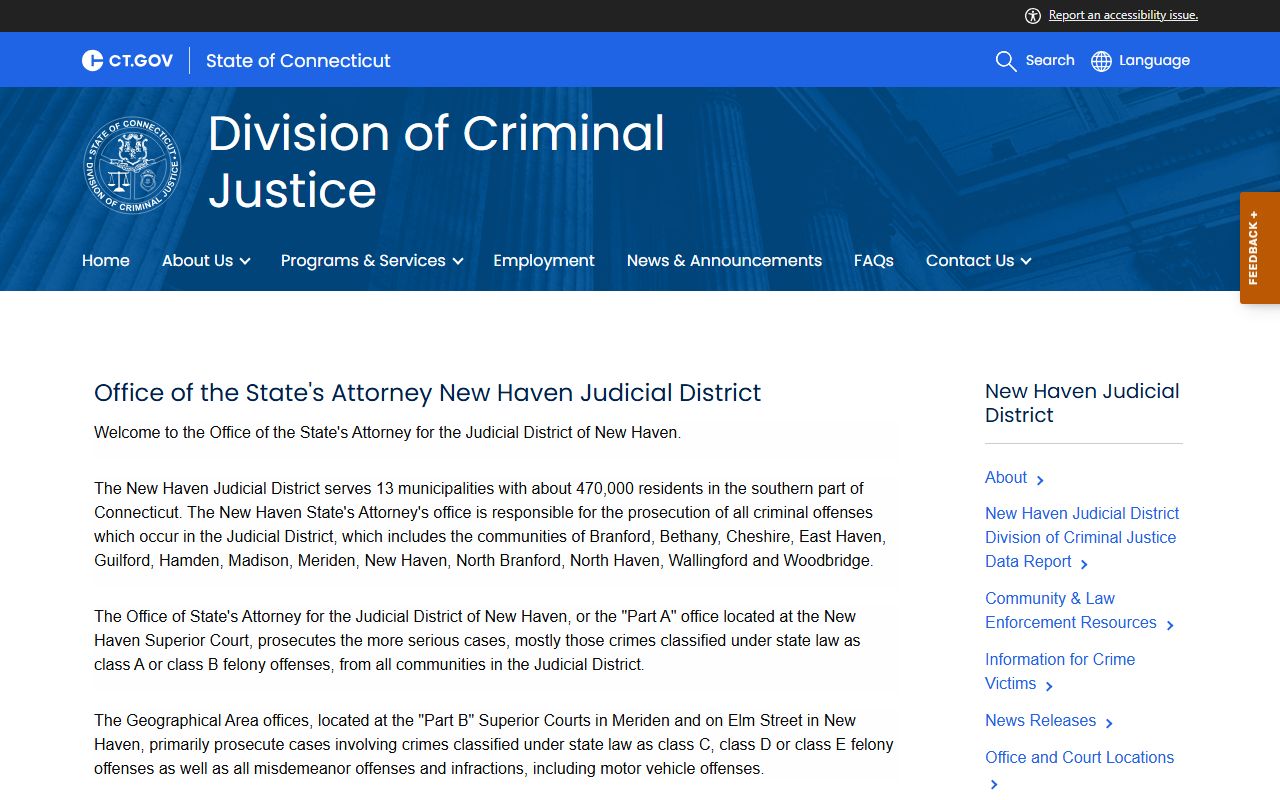
That page is run by the prosecutor, not the court clerk. It explains who files the charges. The searchable court record still comes from the Judicial Branch lookup, while the State's Attorney sets which charges enter the file.
Charge Status in New Haven County Court Records
Charges shift as a case moves. A charge can be added, reduced, dropped, or resolved. The court record shows the current status for each count. The booking charge from the arrest may not match the filed charge, and the filed charge may change again before the case ends. The status terms below carry specific Connecticut meanings.
| Status | What It Means |
|---|---|
| Pending | The case is open and still moving through the court. |
| Disposed | The case has reached an outcome and is closed. |
| Conviction | A guilty plea or verdict was entered on the charge. |
| Dismissal | The charge was dropped by the court and not pursued. |
| Nolle | The prosecutor chose not to proceed; the record erases after a set waiting period if not reopened. |
A nolle is not an acquittal and not a conviction. It is a decision by the State's Attorney to stop pursuing the charge. Under Connecticut law, a nolled charge usually erases after the statutory waiting period passes without the case being reopened. So a court record can show a charge that later vanishes from the public lookup.
Charges vs. Convictions After an Arrest
An arrest and a charge are accusations. A conviction is a finding of guilt. Being arrested and charged does not prove anything. The court record can show both stages, and they sit at very different proof levels. The table draws the line.
| Charge | Conviction | |
|---|---|---|
| Stage | Accusation at filing | Verdict or guilty plea |
| Burden of Proof | Probable cause | Beyond a reasonable doubt |
| Public Record | Yes, while pending | Yes |
| Online Display | Shown as a pending case | Limited to 10 years from sentencing |
The display limit is a key detail. Connecticut's online conviction lookup generally shows a conviction for no more than 10 years from the sentencing date, unless court rules cut it shorter. So a real conviction can drop off the online search while the underlying record still exists with the court. The conviction search by defendant carries these limits, as shown on the official page.
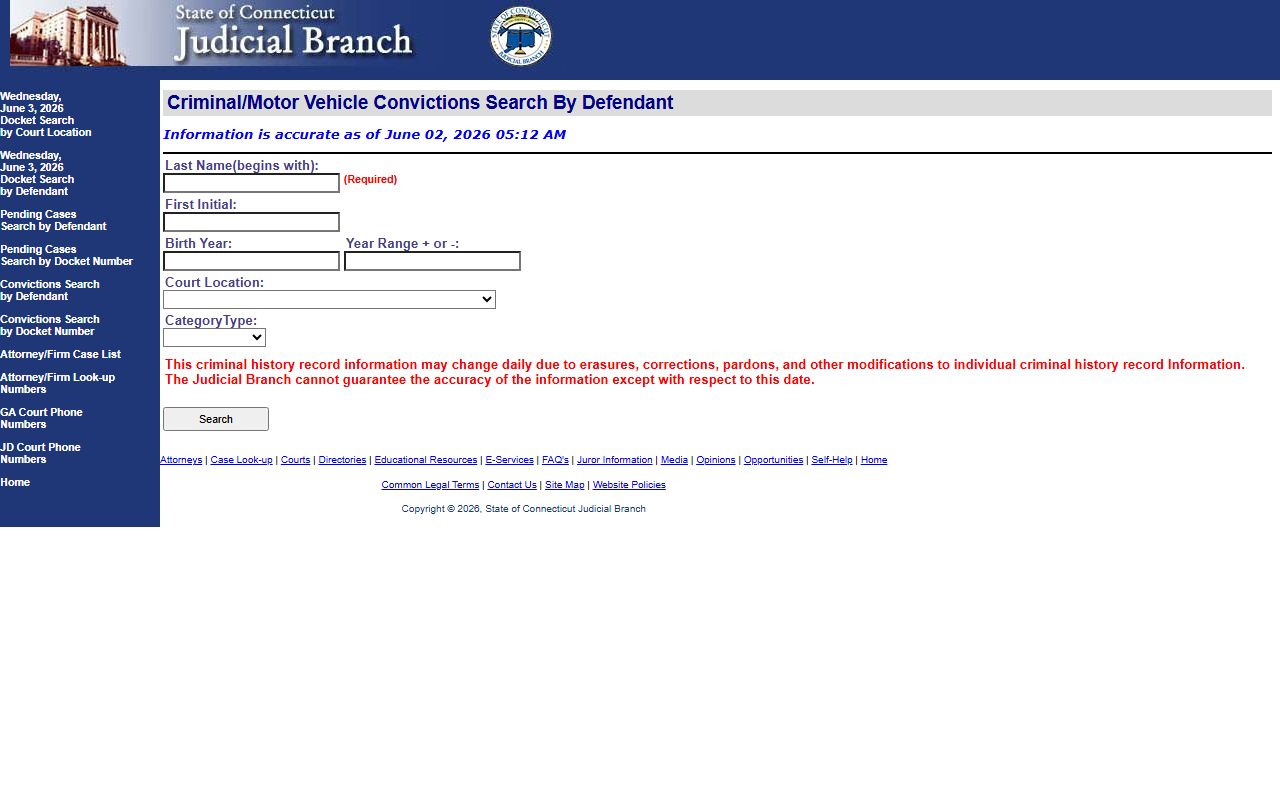
You can run a disposed-case search on the conviction search by defendant page. If a conviction is older than the display window, the clerk's office for that court is the next stop. Note: information that is not available online is generally not disclosable through the clerk either, since both follow the same access rules.
Bond and Release After an Arrest
Bond decides whether a person stays in custody after an arrest. Connecticut sets release conditions by statute, under C.G.S. 54-64a. The law lists a sequence that runs from the lightest condition to the heaviest. A judge or bail commissioner moves up the ladder only as far as needed to make sure the person returns to court. The bond and any conditions show in the court file for the case.
The first rung is a written promise to appear with no money attached. The next adds nonfinancial conditions. After that comes a bond without surety, then a bond with surety, where a bail bond agent may post it. A hold or detainer can block release even when bond is met.
| Bond / Release Type | How It Works |
|---|---|
| Written promise to appear | A nonfinancial agreement to return to court. |
| Promise with conditions | Release with nonfinancial conditions attached. |
| Bond without surety | A court-set amount with no bonding company involved. |
| Bond with surety | Posted through a bail bond agent where the law allows. |
| Cash bond | Money posted to secure the court appearance. |
| Hold / detainer | Another warrant, parole, probation, or immigration issue blocks release. |
A cash bond can be recovered after the case ends. The Judicial Branch says the depositor may collect a cash bond after the case is disposed or sent to a diversionary program. Bring the receipt and a state ID or valid driver's license to the clerk's office at the court where the case was heard. If the receipt is lost or stolen, complete a lost receipt form at that same clerk's office. Confirm the current court location through the case lookup before you travel.
Warrants That Lead to a New Haven County Arrest
A warrant is a common road into custody. A failure-to-appear warrant, a probation violation warrant, or an order to incarcerate can trigger an arrest. Once served, that arrest runs the same path: police processing, court action, and state custody if the person is not released. The court record then opens or reopens around the warrant.
Connecticut hosts a public warrant search for these specific types. It covers arrest warrants for violation of probation, failure to appear, and orders to incarcerate. It is not a full list of every warrant. The page warns that it is informational only, that it does not contain all warrants, and that users should not act against anyone based on the results. A warrant may be left off if posting it could endanger safety or if it came from a youthful offender case.
| Field Label | Type | Required | Notes |
|---|---|---|---|
| Last Name (first two letters) | text | Yes | At least the first two letters are required. |
| First Name (begins with) | text | No | Optional narrowing field. |
| Town | dropdown | No | County towns include Hamden, Meriden, Milford, New Haven, West Haven, and more. |
| Court Location | dropdown | No | New Haven GA 06, GA 23, GA 8, New Haven JD, Meriden GA 7, Milford GA 22, Derby GA 5. |
| Birth Year | number | No | Optional, with a year-range option to widen the match. |
| Search | button | n/a | Runs the warrant lookup. |
You can run this search on the Judicial Branch warrant search page.
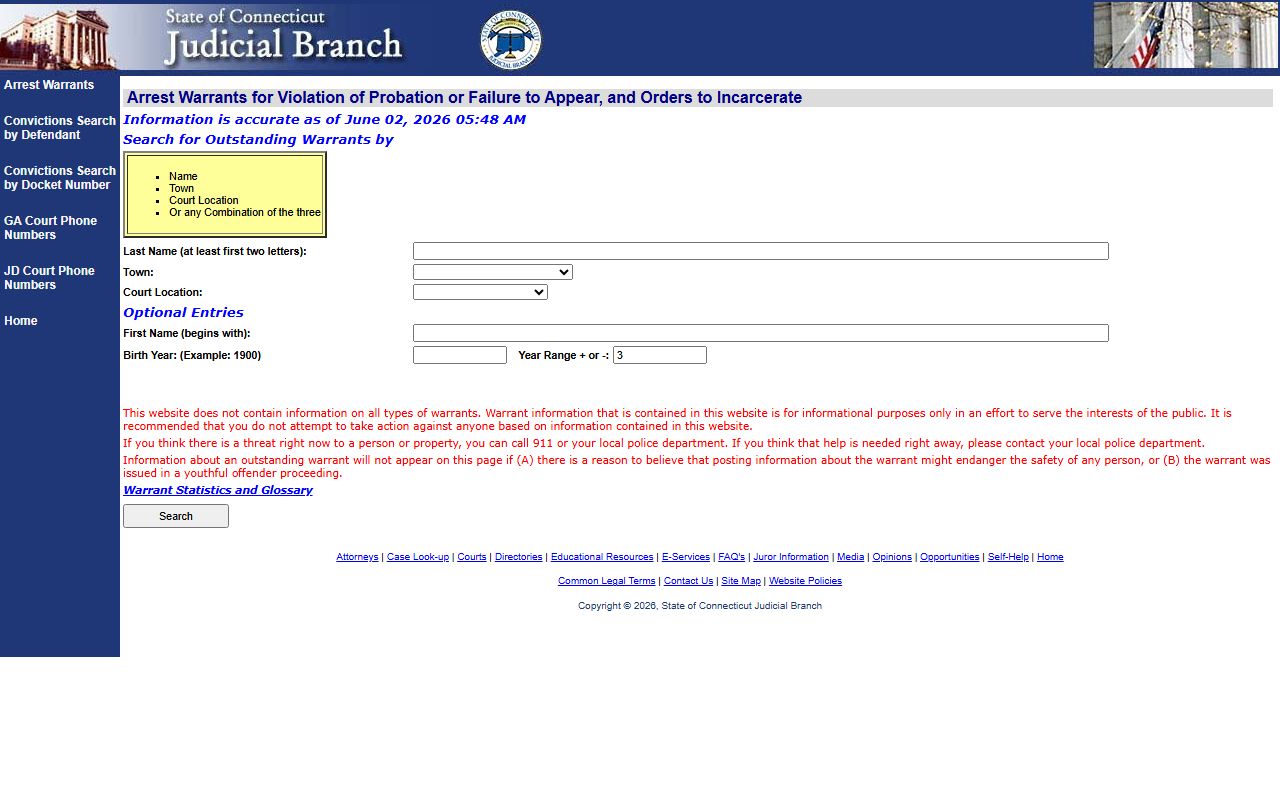
If the online tool comes up empty, the court clerk for the likely court is the next channel. For a safety threat or a police-held warrant, contact local police instead. Once a warrant leads to a booking, the person may appear in the state inmate search after admission.
Erasure Instead of Sealed or Expunged Records
Connecticut does not use the sealed-versus-expunged labels that many states use. It uses erasure. Under C.G.S. 54-142a, qualifying criminal records are erased after certain outcomes. An acquittal, a dismissal, a nolle that clears its waiting period, or a pardon can each trigger erasure. The newer Clean Slate program erases some convictions after eligible time passes. An erased record is treated as if it never happened for most purposes.
The contrast is between records still on display and records the law has erased. The table shows the difference under Connecticut's framework.
| Displayed Record | Erased Record | |
|---|---|---|
| Status | Charge or conviction still public | Treated as if it never existed |
| Online Lookup | Shown, subject to display limits | Removed from the public search |
| Triggers | Pending case or recent conviction | Acquittal, dismissal, nolle, pardon, Clean Slate |
| Mass Buyers | May hold the record | Must delete it under C.G.S. 54-142e |
The mass-buyer rule has real teeth. C.G.S. 54-142e requires companies that buy criminal records in bulk to update and delete records that have been erased. Connecticut's Clean Slate access page explains how erased records work and how to request the right report. The state police also publish a Clean Slate hearing form for disputes over erasure. Note: court records change daily because of erasures, corrections, and pardons, so a result seen one week may be gone the next.
Restricted Court Records After an Arrest in New Haven County
Not every case shows in the public lookup. Some records are restricted by law. Juvenile cases and youthful offender cases do not display like adult cases. Those records are confidential and cannot be searched the way a standard criminal case can. So an arrest involving a minor may leave no public court record at all.
Other limits apply to ordinary cases too. The online conviction lookup caps display at 10 years from sentencing. Erasures pull qualifying records out daily. And the Division of Criminal Justice notes that records not available online are generally not disclosable through the clerk's office either, since both follow the same access rules. So the public search and the clerk usually show the same window.
The takeaway is simple. A missing court record does not always mean no case existed. It may be restricted, erased, or past its display window. For confirmed history, an official report is the surer route than the public case search.
Background Checks vs. the Court Record
The court case lookup is not an official background check. It shows individual cases, not a full criminal history. For a true criminal-history report in Connecticut, the source is the State Police Bureau of Identification at DESPP, not the State's Attorney and not the court clerk. That process runs by mail, and fees apply. It returns the official record rather than a case-by-case snapshot.
You can start a criminal-history request through the State Police Bureau of Identification page. The court lookup is still useful for tracking a single open case after an arrest, checking charge status, and finding the next court date. For a complete and official history, the bureau report is the proper channel.
Important: New Haven County Inmate Population is not a consumer reporting agency under the FCRA, and nothing found here may be used for hiring, housing, credit, or insurance decisions.